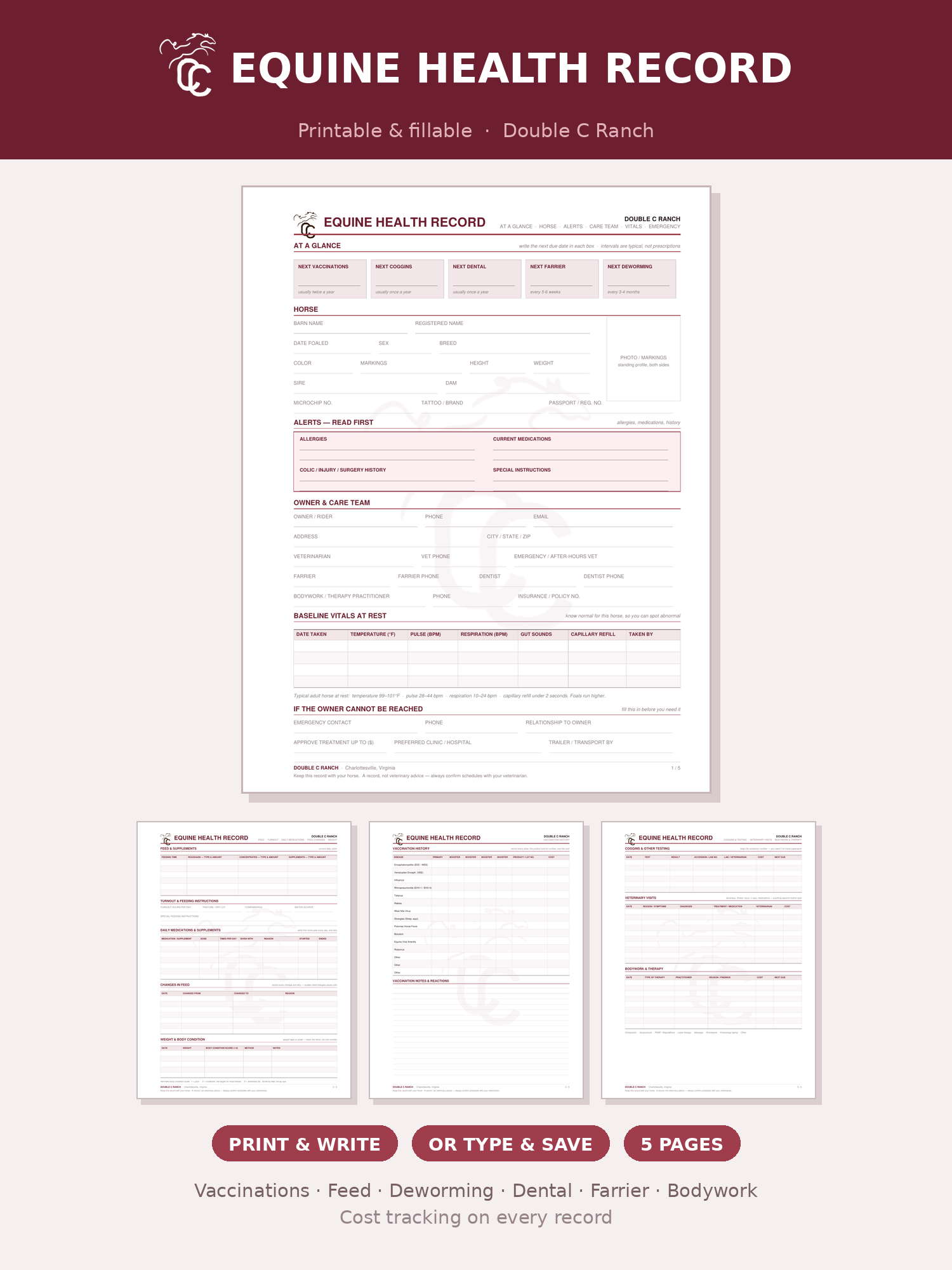
A five-page health record for one horse, made at Double C Ranch — a working riding school in Charlottesville, Virginia. We built it because every form we could buy was missing something.
Three formats. One download. No upgrade to buy.
-
Printable PDF — print it, put it in the barn binder, fill it in with a pen.
-
Fillable PDF — over 600 typeable fields that save what you enter, so you can email records to your vet or a new owner.
-
Spreadsheet (Excel / Google Sheets) — twelve tabs that do what paper cannot.
What the spreadsheet does
-
Works out what is due next. It reads the most recent date from every tab, adds your interval, and tells you how many days away. Overdue turns red. Due within two weeks turns amber. You see it the second you open the file.
-
Adds up what your horse costs. Every tab has a cost column and the Costs tab totals them. Most owners never find out the real number.
-
Sorts and filters. Pull up every rabies shot this horse ever had, everything one vet did, or all of last year — in two clicks.
What makes this different from any other form
-
At a Glance panel across the top of page one — next vaccination, Coggins, dental, farrier and deworming, with typical intervals printed underneath. Most forms only record what already happened.
-
Cost column on every record. Vaccinations, deworming, dental, farrier, vet visits, bodywork.
-
Alerts — Read First box for allergies, medications, colic and surgery history, and special instructions.
-
If the Owner Cannot Be Reached — emergency contact, treatment authorization limit, preferred clinic, and who can trailer. Fill it in before you need it.
-
Baseline vitals at rest, with normal ranges printed on the page. You cannot spot abnormal until you know normal.
-
Fecal egg counts sit above deworming, because the count should drive the plan. Shedder-level thresholds included.
The five pages
1 — Profile. At-a-glance due dates, identification (microchip, tattoo, passport, photo box), alerts, full care team including dentist and bodyworker, baseline vitals, emergency authorization.
2 — Feed & Weight. Daily ration by feeding time. Turnout and feeding instructions. Daily medications and supplements. Changes in feed with the reason, because sudden changes cause colic. Weight and body condition with the Henneke scale.
3 — Vaccinations. Fifteen rows covering EEE/WEE, VEE, influenza, rhinopneumonitis, tetanus, rabies, West Nile, strangles, Potomac Horse Fever, botulism, EVA and rotavirus, plus blanks. Four booster columns, product and lot number, and cost.
4 — Parasites, Dental, Farrier. Fecal egg counts, deworming with body weight and dose, dental procedures, and a farrier record that tracks new versus reset.
5 — Veterinary & Bodywork. Coggins and other testing with accession numbers for travel paperwork. Veterinary visits for lameness, illness, x-rays and medications. Bodywork and therapy — chiropractic, acupuncture, PEMF, laser, massage, shockwave.
Details
- Three files: printable PDF, fillable PDF, and .xlsx spreadsheet
- PDFs are 5 pages, US Letter (8.5 × 11 in), with an extra left margin for a three-ring binder
- The spreadsheet opens in Excel, Numbers, or Google Sheets, and holds 200 rows per tab
- One horse per file — copy it for each horse
- Fillable PDF works best on a computer or tablet with Adobe Acrobat Reader (free), Mac Preview, or most browsers. Some phone apps will not save typed data.
- Personal use across your own horses. Not for resale or redistribution.
This is a record-keeping form, not veterinary advice. Always confirm vaccination, deworming and testing schedules with your own veterinarian.
Digital product — nothing ships, and no refunds once downloaded.